This article was originally published on the Battlefront website. In previous tutorials, we explored different methods for painting camouflage on tanks using soft- or (this, for example) hard-edge patterns (this and this, for example), with or without masking. These techniques typically involved the use of an airbrush, a tool that can seem intimidating to many hobbyists. In reality, however, airbrushing is quite easy, and I highly recommend giving it a try if you have not already. The most critical aspect is cleaning the airbrush properly after each session, and always remember to thin your paints. That said, in this tutorial…
How to quickly paint WWII German vehicles in 15mm
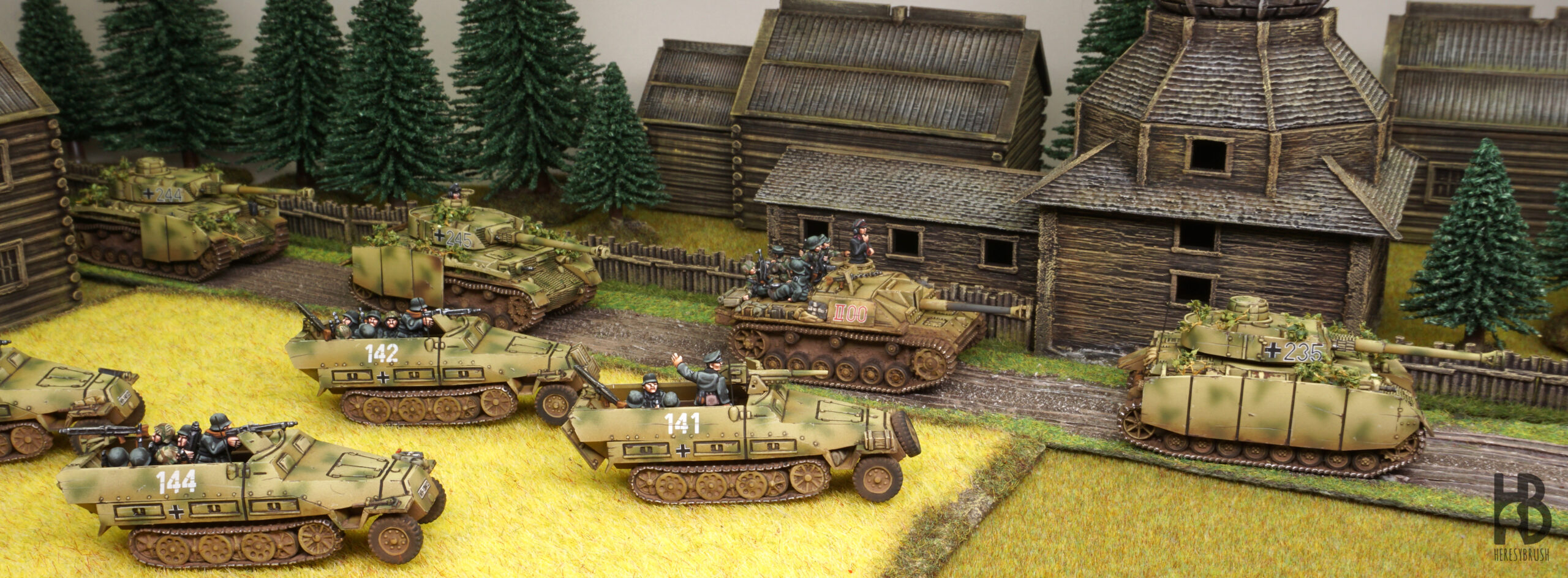
Here, I will describe the ‘speed painting’ method I started using last year to paint two full German armies for Flames of War. Speed painting is a relative term—what might be fast for me could differ for another painter. I consider this method fast because I simplified certain techniques compared to my traditional painting method, like color modulation, and omitted others entirely, such as using oils to create streaking or dust effects, which saved a lot of time. For this project, we will be using either the ATOM acrylic paints or the new IONIC acrylic paints for WWII German Tanks,…
Painting the WWI German AV7 tank: the art of enamel washes
This tutorial was originally published on the Battlefront website, here. Acrylic paints are the most popular choice for wargamers, and in most cases, the only option on the painting bench. This preference is quite logical, as acrylic paints are readily available, non-toxic, quick-drying, and overall user-friendly. However, if we take a closer look at what Scale Modelers do, we will discover that they employ a variety of paint types, including acrylics, lacquers, oils, enamels, and powder pigments. The distinct features of each type of paint can be utilized to perform specific steps or achieve particular effects. Therefore, having a understanding…
Winter camouflage using a washable paint
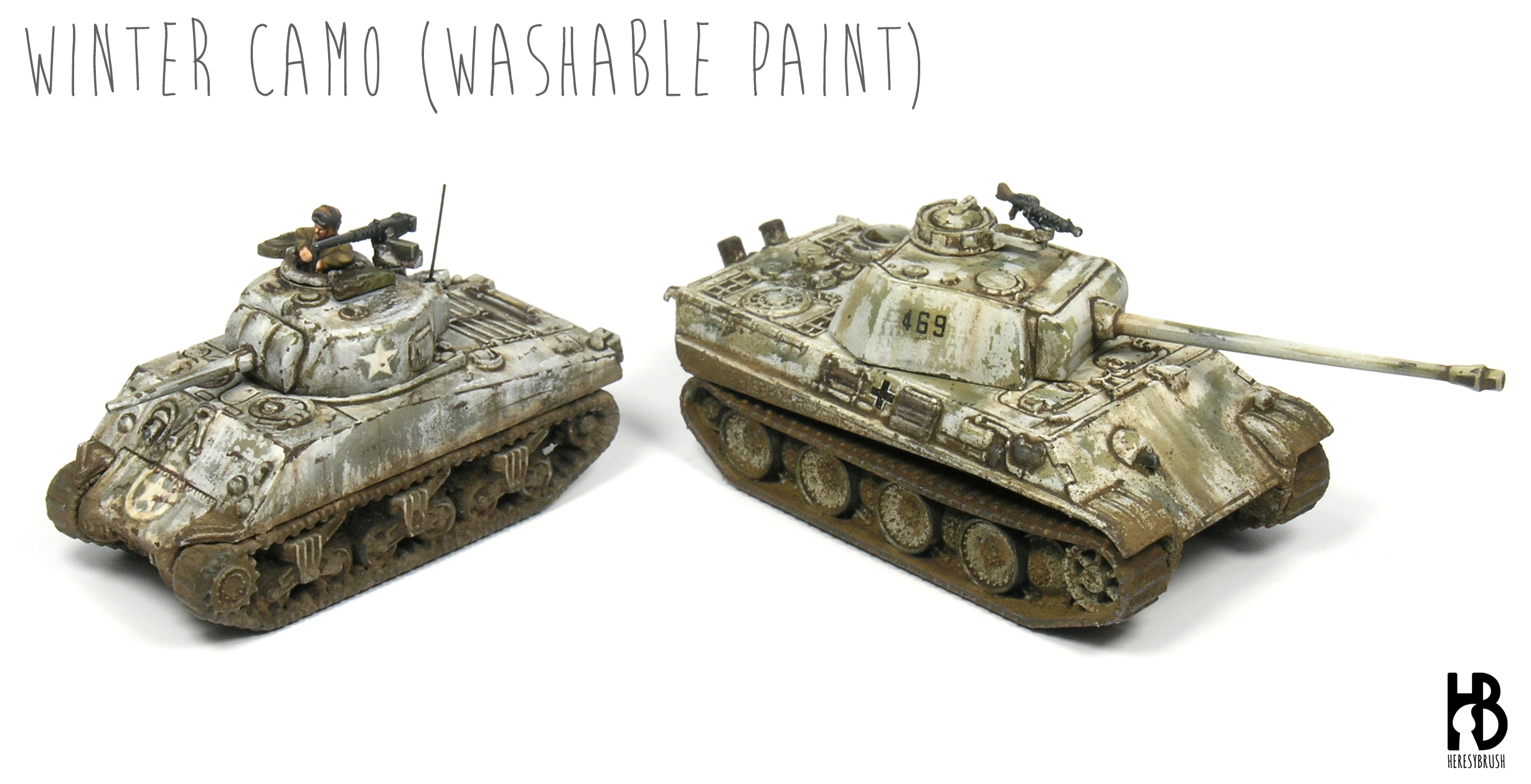
I recently published another post describing the “hairspray technique“, which is commonly used to create a “washable” white camouflage in scale models. During the WWII, this camo was done with a special type of white paint with little grip, so that it was easily removed with water during the thaw, causing effects of wear due to rain and rubbing of crew. However, we can create this type of camouflage following an easier approach with an specific acrylic product: Washable White Camo A.MIG 0024. We only need to apply a single layer and then activate it with water, skipping the…
Camouflages with Chipping Effects fluid (hairspray technique)
This article was published original on 4th of September of 2012. Updated on 4 of April of 2022. In this post we are going to see how to use a Chipping Effects fluid to create worn camouflages where the original base color is exposed. Basically, after painting the base color of the tank, the idea is to apply a thin layer of chipping fluid and on top of this the camouflage. After activating the chipping fluid with water, we will be able to remove small pieces of the camouflage paint applied on top. These Chipping Effects fluids replaces what classically is…
How to paint hard edge camouflage with masking putty
This post was originally published on 12th of February of 2011. And it was updated on 30th of January of 2022 (after reading this I feel very old…). In this article we are going to see how to create a hard edge camouflage (a camo with solid edges rather than blurred) using a very simple tool for masking: removable adhesive putty. The masking will cover part of the tank, so that we can paint the remaining uncovered areas with another color in a very defined way. For example, the camo spots. We can use any mounting putties sold everywhere such…
Color Modulation in 15mm
We have recently talked about several lighting systems for 15mm scale models (this post). One of these systems or styles is the so-called color modulation that we will discuss in further detail in this article. When painting 15mm tanks we can simply apply the desired color, for example olive green for a Sherman, and then just paint the details. But the results will be likely very flat. Furthermore, the tank will look very dark because small objects, such as our small 1:100 models, reflect less light than bigger size objects, such as the real vehicle. Therefore, it is very important…
Lighting styles in 15mm tanks
I originally published this post seven years ago (in 2014). Since then, I have painted dozens (even hundreds) of small tanks and learnt from my mistakes. Therefore, I decided to update this article adding a few more pieces of knowledge based on my experience. In this article I would like to talk about some of the most popular lighting systems applied on scale models (or at least, how I understand them), with a special focus on small tanks in 15mm or scale 1:100. I will briefly review and compare a few of them. If you like this topic, do not…
Painting 15mm tanks: E25 tank hunter
I painted this German tank –one of my favorites WWII tanks, although it was a prototype– two years ago. It is a E-25 tank, produced in 15mm by Khurasan Miniatures. Although I have already published similar painting guides in my blog, I think that there is always something new to learn. The main topic of this article is the combination of the hairspray technique (or chipping effect fluid) with masks to create worn tritonal camouflage. Step 1 – Preparation We remove all imperfections from the model with a modelling knife and files. Then, glue some parts such as hatches, but…
How to paint a British Sherman tank, and a new book: Painting Wargame Tanks
It is a great pleasure to announce a new book published by AMMO of Mig Jimenez where I have actively been collaborating beside Mig Jimenez and Carlos Cuesta. The book contains 96 pages. After a short introduction about general materials and techniques (differences between acrylics and enamels, what is a filter or a wash, how to clean the airbrush…) you can find ten complete painting guides “step by step” of different tanks (mostly Germans, but there are also from USA and Soviet Union). The three firsts pretend to assimilate the knowledge showed in the introduction (we can say “basic level”),…